
Pick up a mass-produced bowl and a handmade one, and you will feel the difference immediately — in the weight, in the texture, in the subtle irregularity that tells you a human being shaped this. That distinction is at the heart of everything Bob Deane makes at Creek Clay Pottery, his studio in Media, Pennsylvania, where every piece begins not in a factory but in the earth itself.
Bob’s ‘creek-to-table’ philosophy means that much of the clay he uses is hand-dug from local Pennsylvania creek beds. It is a practice that sounds simple but carries profound implications: the material has a story before it ever reaches the wheel. When you eat from one of his stoneware pottery pieces, you are in a relationship with a specific landscape—the creek banks, the soil, the place—in a way that no commercially sourced ceramic can offer.
Gas-Fired for a Reason
Not all kilns produce the same result. Bob Deane fires his work in a gas kiln—a deliberate choice that sets his stoneware apart from the majority of studio pottery made today. Gas firing creates what ceramicists call an atmosphere firing: the combustion process, oxygen levels, and flame behavior all interact with the glazes as they melt, producing surfaces that are complex, layered, and subtly unpredictable.
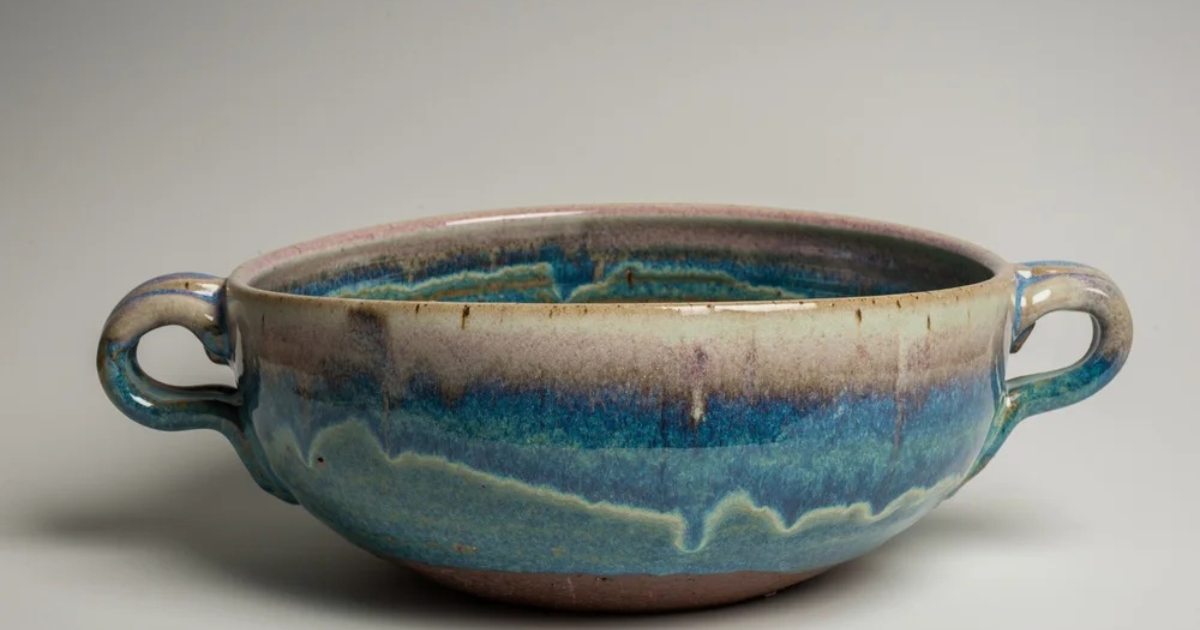
The result is stoneware with a visual depth that is genuinely hard to describe and easy to see. Colors pool differently in recesses than on raised edges. A glaze that appears uniform from across the room reveals shifts in tone and texture up close. These are not flaws — they are the signature of the process, proof that the handmade mugs, bowls, and plates that leave Bob’s studio were made by fire as much as by hand.
Glazes That Live in the Landscape
One of the most immediately striking things about Bob Deane’s stoneware is the breadth of his glaze palette. He works across a wide range: earthy creams, tans, and warm browns that echo the creek banks where the clay was gathered; deep ocean blues and rich purples that bring to mind Pennsylvania skies; and pale greens that nod to mossy banks and wooded hillsides.
This is not decoration applied to functional objects—it is a continuation of the same story the clay itself is telling. A tie-dye serving dish with swirling layers of color, a spotted bowl whose surface recalls river stones, and a leaf-impressed plate that brings the outdoors to the dinner table: every glaze decision deepens the connection between the work and where it comes from. You can see this same sense of place in his sculptural pods and bases, where form and texture carry just as much meaning as color.
Functional Enough for Monday, Beautiful Enough for Saturday
What separates Bob Deane’s stoneware from purely decorative ceramics is its commitment to use. His pieces are high-fired to create a dense, durable clay body—many are microwave and dishwasher safe. Casserole dishes are built to go from oven to table. Pitchers are sized and weighted for actual pouring. Mugs fit the hand the way a good tool should.
This is pottery that earns its place not by sitting on a shelf but by showing up at every meal. If you want to experience making that connection yourself, Bob also offers pottery classes at his Media studio — a chance to feel firsthand what it means to work with clay that comes from the land around you. Learn more about the values behind the work in Bob Deane’s Artist Statement.
Handmade stoneware belongs on every table because it makes the ordinary feel considered. It asks nothing of you except that you use it — and in doing so, it gives back something that mass production never can: a small, daily reminder that beautiful things are still made by hand, from the earth, by people who care.