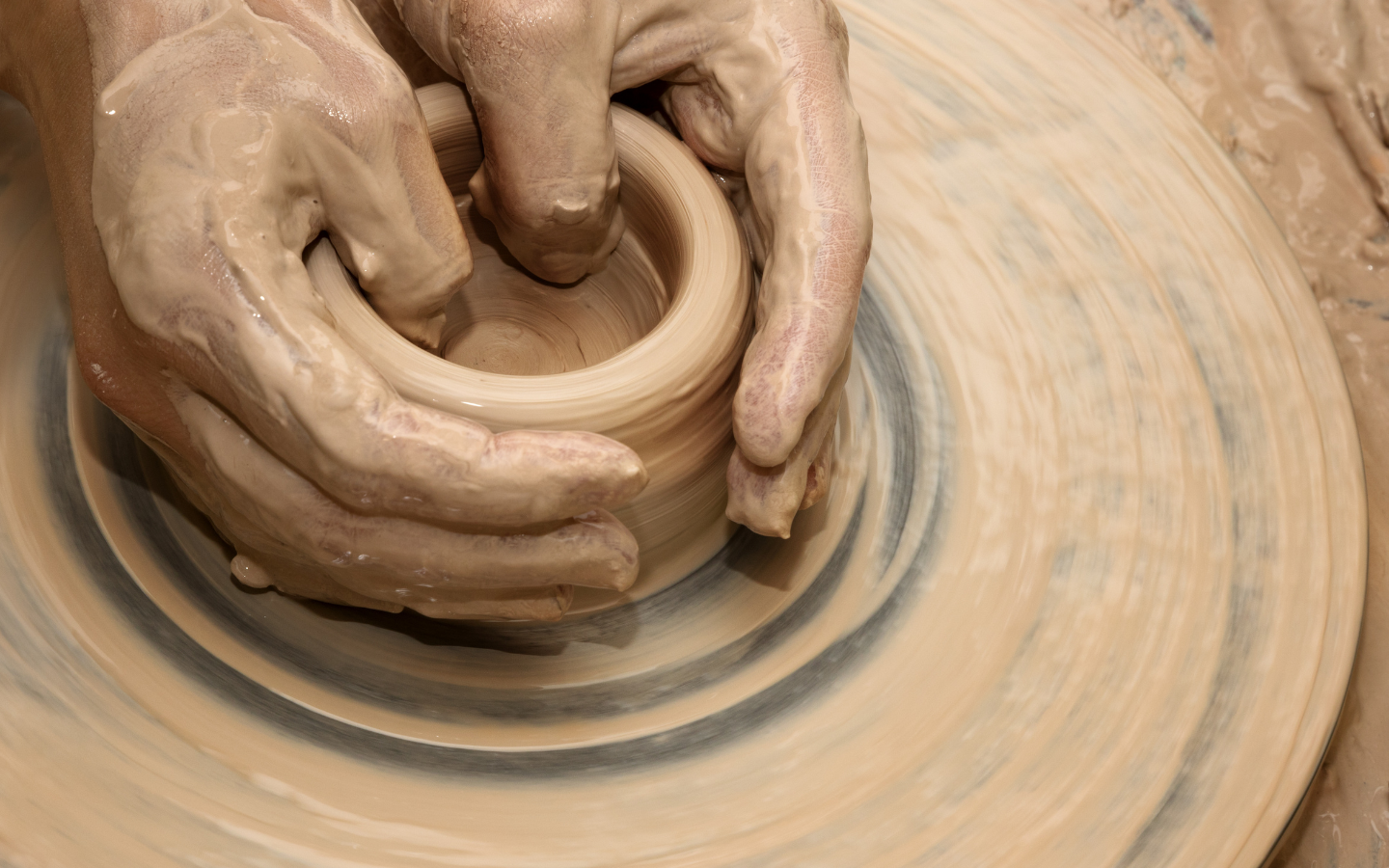

Every craft has a moment of surrender — a point at which the maker releases control and trusts the process to finish what the hands began. For a woodworker it might be the final coat of oil, soaking in and revealing the grain. For a glassblower it is the annealing oven, slowly drawing out the stress. For a potter, that moment is the firing. And for Bob Deane, working from his studio in Media, Pennsylvania, the firing happens in a gas kiln — a decision that shapes everything about the character of his finished work.
It is worth understanding why that choice matters. Walk into any craft fair or ceramics gallery today and the majority of work you see has been fired in an electric kiln. Electric firing is clean, consistent, and controllable. It produces reliable results and uniform surfaces. Those are genuine virtues — but they come at a cost. The very predictability that makes electric firing efficient also makes it flat. What it cannot produce is the atmospheric complexity that defines the surfaces of Bob’s stoneware pottery — the depth, the variation, the sense that something alive happened during the firing.
What Makes Gas Firing Different
A gas kiln operates through combustion: propane or natural gas burns inside the kiln chamber, and the products of that combustion — heat, carbon monoxide, and unburned gases — interact directly with the clay and glazes being fired. By adjusting the ratio of fuel to air, a potter can create what is called a reduction atmosphere: an oxygen-starved environment in which the flame begins pulling oxygen from the metallic oxides in the glaze itself.
That oxygen transfer is where the magic happens. Iron oxide in a neutral atmosphere produces a warm tan. In reduction, that same iron can shift toward grey, rust, or a rich reddish-brown depending on the temperature and timing. Copper oxide, which fires green in an electric kiln, can produce a deep, saturated red in heavy reduction. The kiln does not simply heat the glaze — it chemically transforms it. This is why you cannot look at a raw-glazed Bob Deane piece and predict exactly what it will look like after firing. The creek clay pottery you see in his collection is the result of that negotiation between intention and atmosphere.
The Firing as a Skill in Itself
Operating a gas kiln well is a craft entirely separate from throwing and glazing — and in many ways more demanding. A firing typically takes eight to twelve hours, during which the potter monitors temperature, adjusts dampers, shifts fuel and air ratios, and reads the kiln’s behaviour through peepholes and draw tiles. Too fast a temperature rise and the work can crack. Too heavy a reduction too early and glazes can blister. The timing and sequencing of a gas firing is knowledge that accumulates slowly, through firings that succeed and firings that do not, over years of paying close attention.
This is visible in the results. Pick up one of Bob Deane’s handmade mugs and look at the glaze surface closely. You will see colour that moves across the form — not uniformly, not predictably, but in a way that reads as natural rather than applied. You will see where the flame left its signature: a slight warming on one side, a softening toward the base, a breaking of colour along the rim where the glaze ran thinnest. These are not accidents. They are the marks of a controlled, skilled, atmospheric firing — and they are irreproducible in any other kiln type.
Why It Matters to You
You do not need to understand reduction atmospheres or pyrometric cones to appreciate the difference that gas firing makes. You simply need to hold two mugs — one electric-fired, one gas-fired — and feel the difference in the surface under your thumb. One is smooth in a uniform, almost synthetic way. The other has texture and depth that draws the eye inward. One looks finished. The other looks alive.
That aliveness is what Bob Deane’s gas kiln produces in every piece — from the wide serving bowls and pitchers of his functional range to his sculptural work and expressive sculptural pods and bases. If you want to understand the full process from raw earth to fired form, his pottery classes open the studio to anyone curious — and his Artist Statement articulates the philosophy behind every firing.